

-
By
-
July 19, 2026
-
No Comments
Every civilization has had to decide, in one way or another, what to do with eros — the current of attraction and desire that runs through ordinary life whether religion accounts for it or not. Looked at broadly, two distinct strategies emerge across traditions, worth examining side by side, not to rank them, but to understand what each one is actually solving for, and what each one costs.
Integration: bringing eros inside the sacred
What stands out about much of the Indic tradition is that it largely declined to treat eros as spirituality’s enemy. This shows up structurally, right at the foundation: the four purusharthas — the classical goals of a human life — explicitly include kama, desire and pleasure, alongside dharma, artha, and moksha. Desire isn’t excluded from a well-lived life; it’s positioned as one legitimate strand of it, to be understood and refined rather than denied outright.
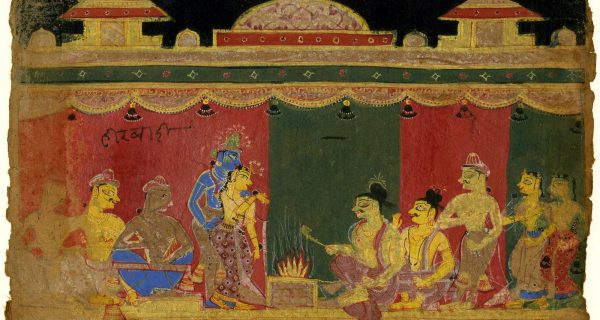
This logic plays out visibly in the culture’s art. Temple sculpture at sites like Khajuraho or Konark places frankly erotic imagery on the outer walls of sacred structures — a fairly direct architectural statement that beauty, desire, and sanctity are not separate categories requiring separate spaces, but part of a single continuum, with awareness rather than denial as the actual dividing line. The Krishna narratives work similarly: the Rasa Lila uses the vocabulary of romantic longing to describe devotion, transmuting erotic metaphor into bhakti rather than literal indulgence. Tantra and yoga extend this further still, treating sexual energy as one visible expression of shakti — the same creative power understood, elsewhere, as consciousness itself — capable of being directed and refined through disciplined awareness rather than suppressed.
The plausible effect of growing up steeped in this kind of art and story is a particular kind of emotional conditioning: sensual beauty doesn’t automatically register as transgression or trigger reflexive guilt, because the surrounding culture has already metabolized it as part of ordinary life rather than an intrusion into sacred space. This isn’t permissiveness so much as cultivation — training the nervous system toward modulation rather than repression.
Avoidance: containment through boundary
Judaism, Christianity, and Islam have, broadly speaking, favored a different strategy: containment through modesty codes, clear behavioral boundaries, and firm moral structure. This isn’t rooted in treating the body as inherently corrupt — that’s a common oversimplification — but in a judgment that unregulated desire poses a genuine threat to family stability, communal order, and devotional focus, and that clear lines serve those goods better than ambiguity does.
This approach buys real things: social clarity, protection for the vulnerable, a stable structure for family and community life that doesn’t depend on everyone individually working out where the boundaries are. What it can cost, when it hardens into rigid enforcement rather than genuine internalized discipline, is a sharper split between the sacred and the sensual — and, in some times and places, an oscillation between severe suppression and its equally severe opposite, rebellion against the very boundaries meant to provide stability.
Neither model is free of cost
It would be a mistake to read this comparison as a verdict in favor of integration over avoidance. The same civilization that produced temple erotica and Krishna’s Rasa Lila also produced, at various points in its long history, severe ascetic extremes, rigid patriarchal codes, and its own forms of moral policing around sexuality — no tradition sustains perfect equilibrium indefinitely, and the Indic model’s breadth (room for both the householder and the renunciate, both the ascetic and the artist) is better understood as an aspiration the tradition reached for, imperfectly, rather than a guarantee it always delivered.
Likewise, avoidance-based traditions have produced their own rich interior lives, their own mystics and poets who found in restraint not repression but a different, equally valid path to depth and devotion. The costs and benefits run in both directions, and a fair reading holds both without needing to crown one civilization’s strategy as simply correct.
The principle underneath both strategies
What both approaches, at their best, seem to be circling is the same underlying claim, phrased in very different cultural languages: energy itself isn’t the problem — unawareness of it is. Met with awareness, whether that awareness is cultivated through symbolic integration or through disciplined boundary, desire can refine into art, affection, and devotion. Met with either fear or unexamined indulgence — the failure modes on either side of both strategies — it tends to fragment instead, into obsession, shame, or harm.
Seen this way, temple architecture that “trains the gaze” toward reverent appreciation and a modesty code that trains the gaze toward restraint are doing recognizably similar work through opposite means: both are attempts, however imperfectly executed across history, to educate the senses rather than simply leave them to run untrained. The more useful question for any individual, regardless of which tradition they were raised inside, isn’t which civilization got it right. It’s whether their own inherited strategy — integration, avoidance, or some blend — has actually left them with awareness, or merely with rules obeyed without ever being understood.


Related Post




@ 2025 Copyright. Design & Developed by
NexKode Lab